If you can hear the leak, it’s costing you.
Compressed air leaks quietly burn compressor capacity and power. Our one-day leak survey finds the leaks you know about and the ones you don’t, then puts hard numbers on each one.
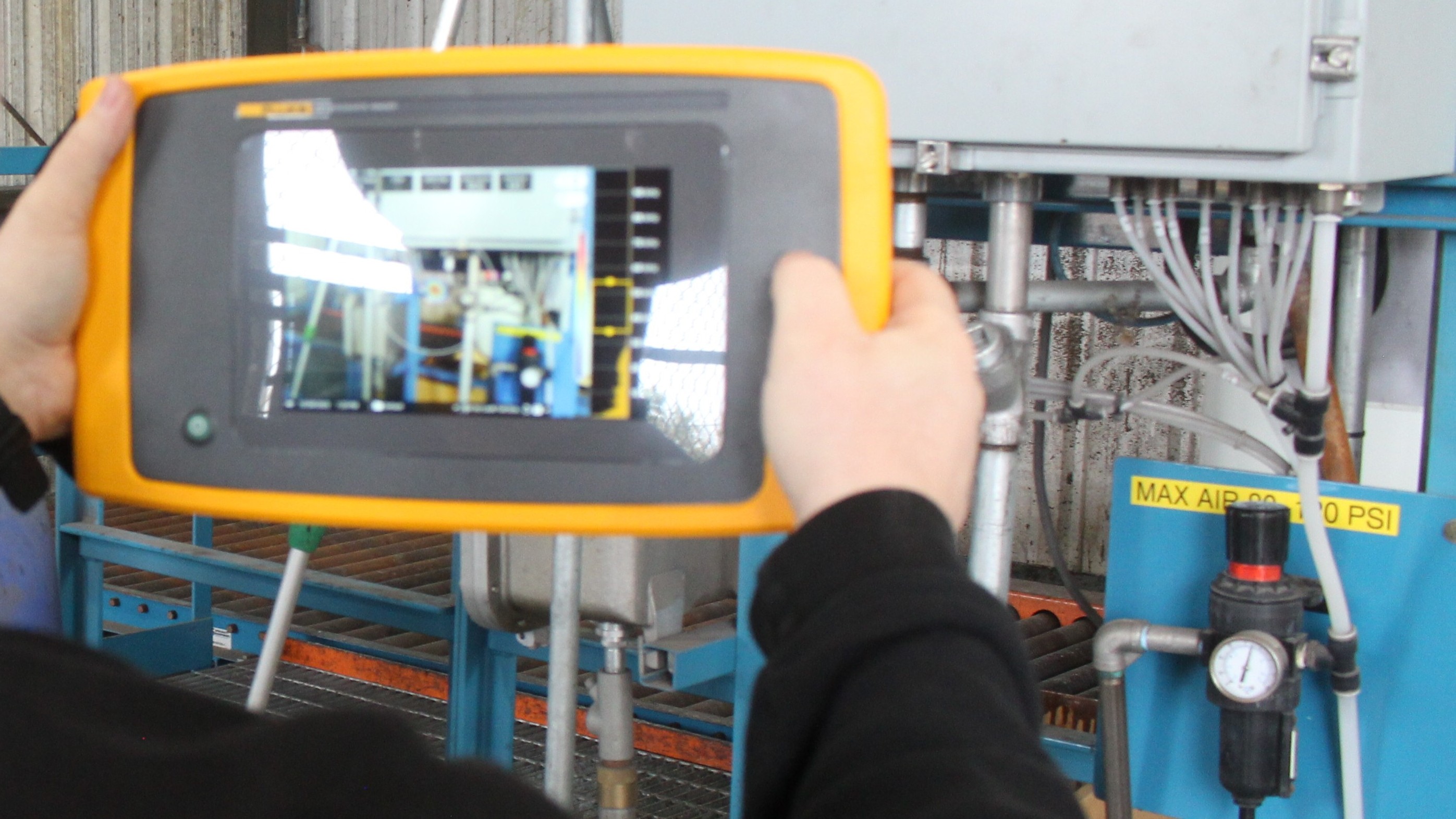
- Acoustic/ultrasonic detection — including leaks you can’t hear in a running plant
- Leaks tagged so your team can find them fast
- Clear report + full ranked leak list (highest $/yr first)
Why one “little” leak adds up so fast
Compressed air is one of the most expensive utilities in a plant. You pay to compress, cool, dry, and distribute that air — and then leaks let it go to waste.
A single 75 hp compressor running multiple shifts costs tens of thousands of dollars per year in electricity alone. When part of that output is feeding leaks instead of production, the cost adds up quickly.
In a noisy plant, many small leaks are effectively silent beyond arm’s length. If you can hear a leak at all, it’s a good rule of thumb to assume it’s costing you real money every year.
Estimate what one leak is costing you
Use this calculator to get a quick estimate of what a compressed air leak might be costing your plant in wasted energy.
Plug in your typical pressure, an estimated leak size, how many hours you run, and your power rate. The calculator will estimate leak flow, compressor power, and annual energy cost.
Compressed Air Leak Cost Calculator
Estimate how much you’re spending on compressed air leaks every year, in dollars, cfm, and kWh.
Estimated Annual Leak Cost
$0 / year
Assumptions & notes
- Assumes compressor specific power of 18 kW per 100 cfm of delivered air.
- Individual leaks mode uses approximate leak orifice tables at ~100 psig; actual flows vary with pressure and orifice geometry.
- Results are estimates for energy waste only, not a quote. They exclude maintenance costs, production losses, or pressure-side impacts.
Next step: compressed air leak survey
Pick Your Survey DayOur one-day Compressed Air Leak Survey is $1,950. Most plants recover multiples of that in the first repair cycle.
Did you know?
In a noisy plant, many air leaks smaller than about 1/16" are effectively silent beyond arm’s length. If you can hear it, it’s not a nuisance — it’s a cost.
This is only one leak. Most plants have many — including leaks you can’t hear in a running plant. That’s what the one-day leak survey is for.
Our One-Day Leak Survey
We treat compressed air leaks like any other maintenance defect: find them, quantify them, and make it easy to fix the highest-impact ones first.
Our instruments usually allow us to cover most, if not all, of typical compressed air systems. For very large systems, we start with the main distribution headers and the most likely leak areas and then work outward.
What happens onsite
Scan + pinpoint
Walk headers, drops, lines, and equipment with acoustic/ultrasonic detection to find leaks you can’t hear.
Tag every leak
Mark each leak with an ID so your team can put hands on it without playing scavenger hunt.
Log details that matter
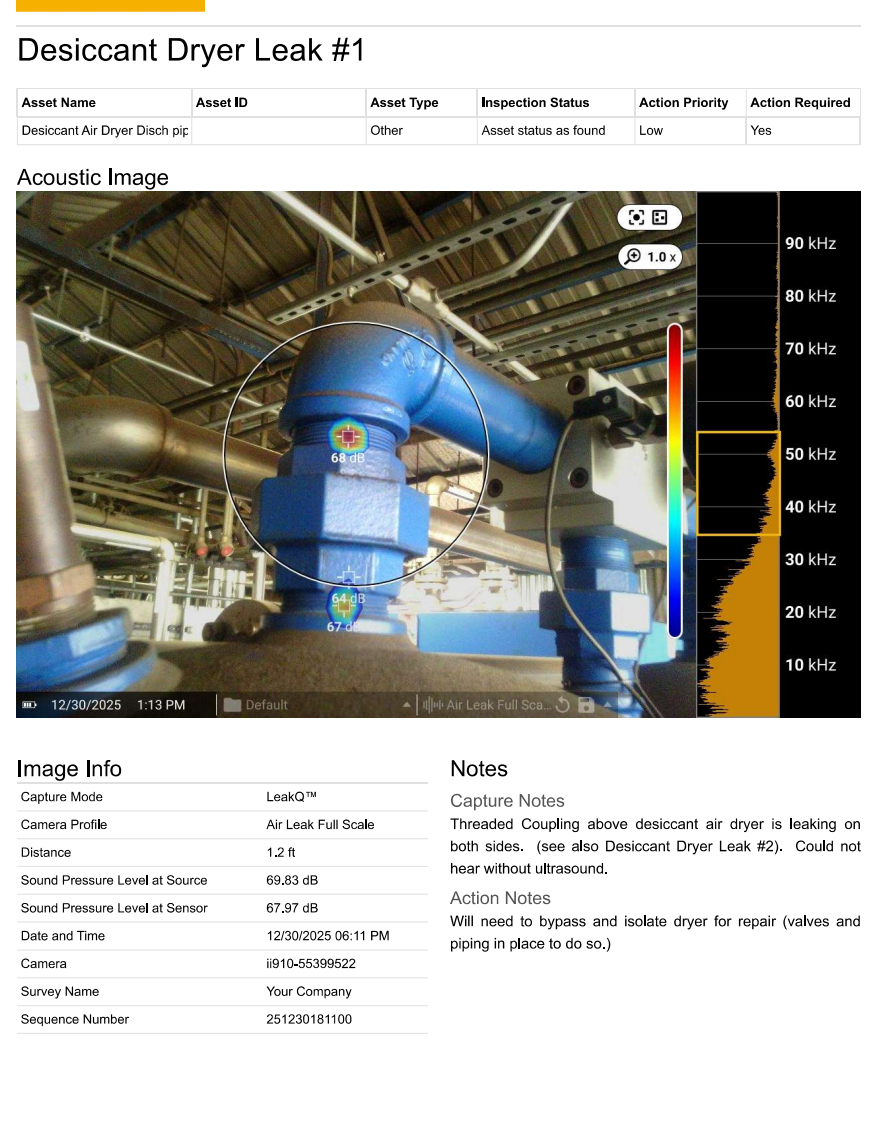
Location, component, notes, photos, and an estimated leak flow/cost for prioritization.
Roll-up + priority order
Total estimated waste + a ranked list (highest $/yr first) so the first repair cycle hits the big wins.
What you get after we leave
Within a few days of the site visit, you’ll receive deliverables you can use with your team and with corporate. The goal is simple: make it easy to act.
Concise PDF summary
Total estimated leak load, kWh/year, and $/year wasted — plus clear recommendations.
Full ranked leak list
Every leak we find, ranked by estimated $/yr impact (so you start where it pays).
Photos + notes
So your techs can identify the exact component and understand what’s involved to repair it.
Spreadsheet formatted for your system
Leak IDs, locations, components, estimates, and notes in a format you can import or turn into work orders.
Pick your survey day
Our one-day Compressed Air Leak Survey is a fixed $1,950. Share a few details and we’ll confirm a date that works for your plant.
Prefer a quick call instead?
Phone:
904-646-6470
•
Email:
leak_survey@advanced-industrial.com
How the leak cost math works (for the curious)
The leak cost estimates on this page and in the calculator use simple, standard compressed air math:
- Estimate leak flow (cfm) from plant pressure and estimated leak size/orifice
- Convert cfm to compressor power using typical specific power for industrial compressors
- Multiply by your operating hours and $/kWh to estimate annual energy cost
Actual numbers in your plant will vary with compressor type, controls, system design, and operating pattern, but the order of magnitude is real — especially when you add up multiple leaks.
How this calculator works (same as above)